
Cold plasma, engineered for facility airflow
ADB exposes ambient air to controlled electrical pulses inside the reaction chamber, creating non-thermal cold plasma. Reactive oxygen compounds and peroxides then move through your HVAC or standalone unit to contact microbial contamination in the air and on exposed surfaces.
Non-thermal plasma from ambient air
A high-frequency, controlled electrical field energizes ambient air without heat. The process generates reactive oxygen species, including gas-phase hydrogen peroxide at levels stated to be below applicable regulatory thresholds, along with trace ozone below applicable emissions limits.
Treatment moves with the facility airflow rather than a fixed beam of light. ADB is not limited to line of sight. It integrates with existing HVAC or operates as standalone units sized for room volume, airflow, and treatment objectives.
Distributed through airflow
The facility HVAC system or unit fan carries treatment through the space so it can contact microbial contamination wherever treated airflow reaches.
Reactive, then benign
Reactive species treat susceptible microorganisms throughout the treatment space, then break down into water vapor and non-reactive oxygen according to PathogenFocus technical materials.
Damages microbial structures
The treatment damages microbial structures and genetic material, rendering susceptible organisms inactive and reducing microbial burden under defined test conditions.
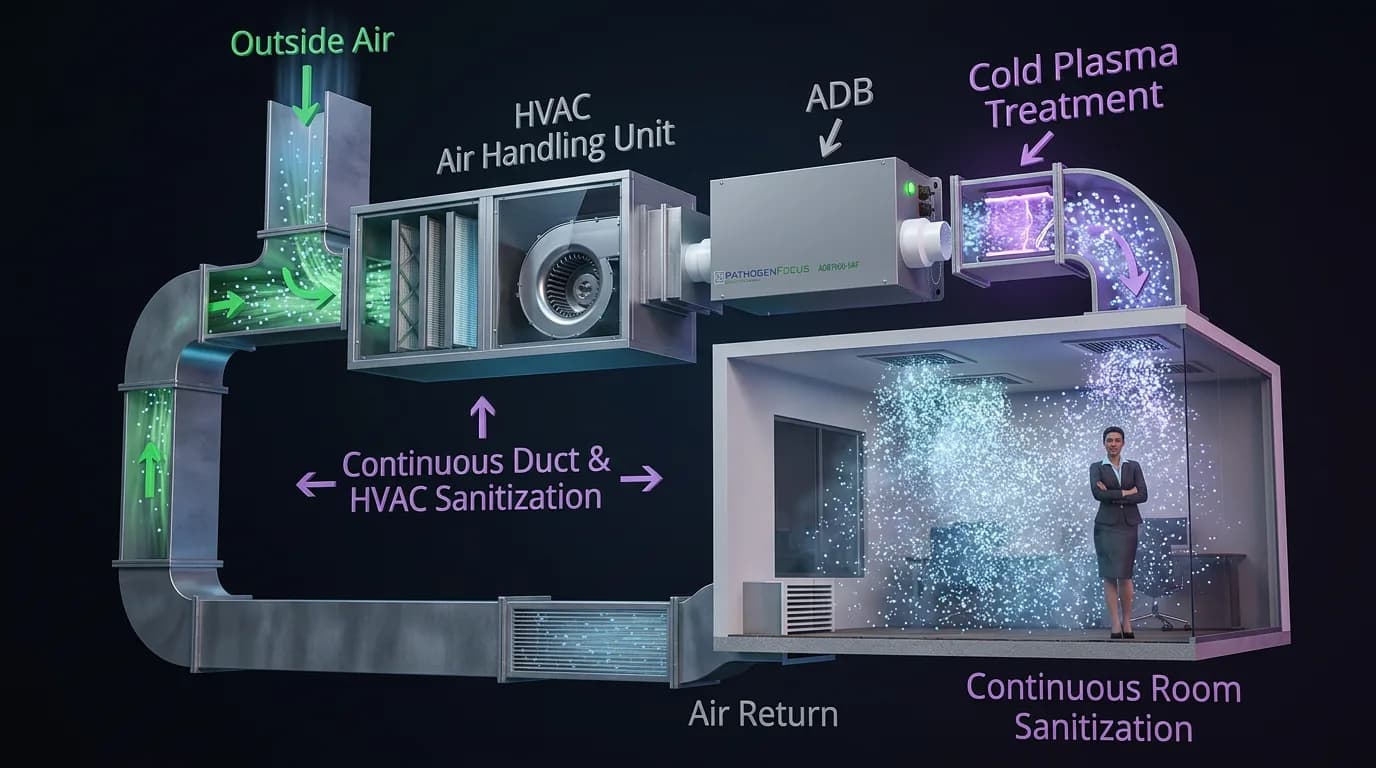
Air treated at every turn
From the intake hood to the air return, ADB energizes the moving air stream and keeps working in the duct, the HVAC, and the occupied room wherever treated airflow reaches.
- Cold-plasma treatment at the ADB reaction chamber
- Reactive species carried through the full duct run
- Continuous treatment in occupied breathing-zone air
Four steps, running continuously
Capture
Ambient air enters the ADB reaction chamber. The system uses the air already in the facility, not added chemical treatment products.
Energize
Controlled, high-frequency electrical pulses create non-thermal cold plasma inside the chamber, generating reactive oxygen compounds and peroxides.
Disperse
Reactive species, including gas-phase hydrogen peroxide, move through the HVAC system or the unit fan into the treatment space.
Treat and revert
Reactive compounds contact susceptible airborne and surface microorganisms, reducing microbial burden. Unreacted molecules return to water vapor and non-reactive oxygen, according to PathogenFocus technical materials.
Our system works while you work.
Most ADB configurations run continuously while people are present. The system requires no added chemical treatment products for routine operation. The ADB 7000-8MT is intended for unoccupied enclosed spaces only.
Airborne SARS-CoV-2 results
In independent laboratory testing conducted in a 2,640-cubic-foot chamber, ADB reduced airborne SARS-CoV-2 by 90% in 16 seconds and by 99.9% in 30 seconds. Real-world results vary based on facility conditions.
90% airborne SARS-CoV-2 reduced
99.9% airborne SARS-CoV-2 reduced
2,640 cu ft test chamber
Comparative airborne reduction in one minute
2,640 ft³ chamber, third-party labIndependent third-party comparison in a 2,640-cubic-foot chamber after one minute. PathogenFocus MDBD achieved a 7.74-log reduction, reported as 99.99998%. Real-world results vary with facility conditions. Bars use a perceptual scale for legibility.
Organism-specific laboratory testing
PathogenFocus materials reference third-party testing involving the organisms below. Each claim remains tied to its own study, organism, surface or airborne condition, exposure time, and laboratory method. Do not assume every model produces the same reduction against every organism in every facility.
Viruses
Bacteria
Fungi
Full methodologies include Association of Official Analytical Chemists (AOAC) and Bacteriological Analytical Manual (BAM) methods. PathogenFocus does not make health claims. The MDBD system is not intended for use on medical devices.
Documented certifications for applicable models
Every public certification claim matches the covered model, certificate scope, and current documentation. UL 2998 Zero Ozone is a verification standard with an emissions threshold, not a literal zero measurement.
- USDA National Organic Standards 7 CFR 205
- UL 2998 Zero Ozone verification (emissions threshold)
- CARB Certified, California ozone limits
- UL867 (ADB 7000-AF)
- Certified Halal, Islamic Services of America